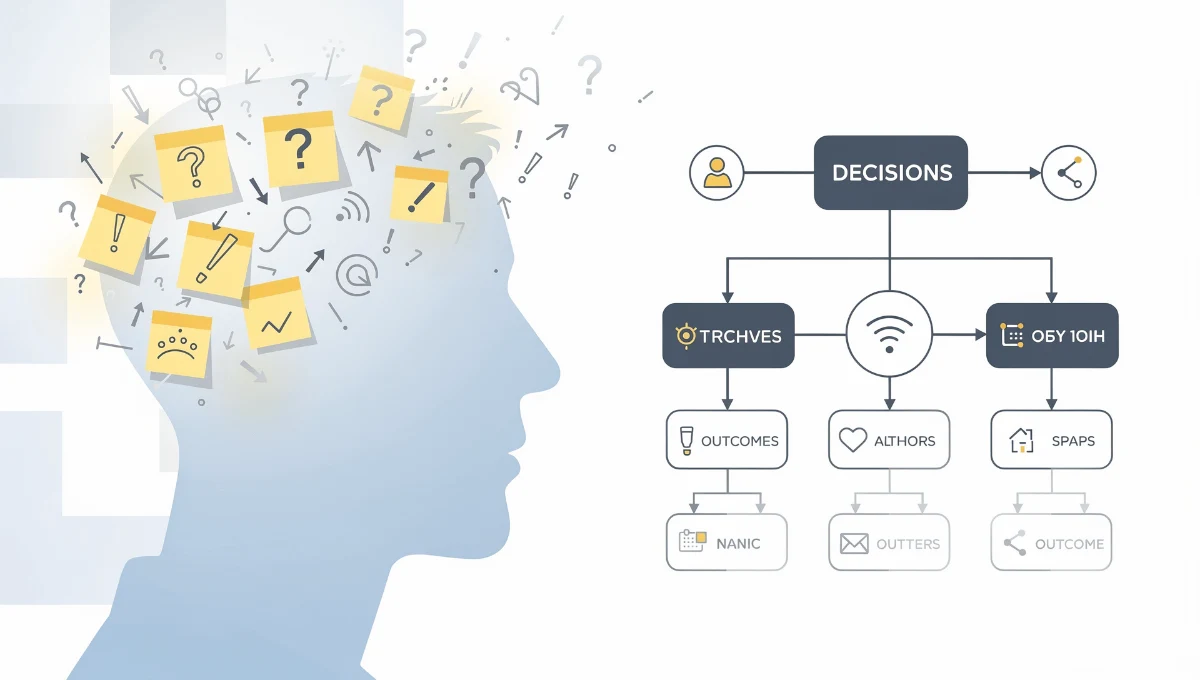
Most strategy failures don’t happen in meetings.
They happen weeks later.
Someone forgets why a decision was made.
Context fades. Assumptions blur.
A new person joins and asks the most dangerous question in strategy:
“Why are we doing this again?”
What follows is not alignment—it’s reconstruction.
Opinions replace context. Confidence replaces evidence.
And strategy quietly turns into a memory game.
Strategy Breaks Where Memory Takes Over
Organizations expect people to remember:
- Why a priority was chosen
- What alternatives were rejected
- Which assumptions mattered
- What trade-offs were accepted
This expectation doesn’t scale.
Harvard Business Review highlights that execution failures often stem from lost context and unclear decision logic—not poor intent.
Strategy isn’t lost because people are careless.
It’s lost because human memory is not a system.
The Hidden Cost of Strategic Amnesia
When strategy depends on memory:
- Decisions are re-litigated
- Alignment resets with every team change
- Execution drifts without anyone noticing
- Leaders rely on intuition instead of evidence
McKinsey notes that organizations struggle to translate strategy into action when decision rationale isn’t consistently embedded into operations.
Each forgotten decision forces a rebuild—slowing teams and eroding trust.
Strategy Needs Infrastructure, Not Recall
No serious organization relies on memory for:
- Financial records
- Customer data
- Operational processes
Yet strategy—the most consequential layer—often lives in:
- People’s heads
- Old slide decks
- Scattered notes
- Fading recollections
That’s not strategy management.
That’s institutional risk.
Strategy must be treated like infrastructure—persisting beyond individuals.
Strategy as a System of Record
A real strategy system does three things:
1. Preserves Decision Context
Not just what was decided—but why, when, and based on which signals.
2. Connects Intent to Execution
Objectives, initiatives, and roadmaps remain traceable to original intent.
3. Enables Continuous Validation
Teams don’t debate from memory—they validate against recorded context.
MIT Sloan Management Review emphasizes that adaptive organizations institutionalize decision logic, not just outcomes.
Strategy becomes navigable, explainable, and durable.
What Changes When Strategy Stops Relying on Memory
When strategy becomes a system:
- Onboarding accelerates
- Decisions compound instead of resetting
- Alignment survives personnel changes
- Leadership debates become sharper, not louder
Teams stop guessing.
They start building on shared understanding.
Why Strategy Still Lives in Memory
- Systems are built for execution, not intent
- Strategy tools focus on output, not reasoning
- Documentation is static, not contextual
- Memory feels “good enough”—until it isn’t
Most teams don’t avoid systems intentionally.
They simply never had one designed for strategy.
This Is Not About Documentation
A strategy system is not:
- More slides
- Longer documents
- Better note-taking
It’s about persistent, queryable context.
Memory fades.
Systems don’t.
Strategy Shouldn’t Depend on Who Remembers Best
Organizations don’t lose strategy because they lack intelligence.
They lose it because intelligence isn’t preserved.
Strategy that depends on memory will always decay.
Strategy that lives in a system compounds.
That’s the difference between alignment that lasts
and alignment that resets every quarter.
❓ Mini FAQ — Strategy Is a System, Not a Memory Game
Why does strategy fail after decisions are made?
Because context and rationale fade, forcing teams to reconstruct decisions from memory.
Is this just a documentation problem?
No. Documentation stores outcomes. Strategy systems preserve reasoning and intent.
How does strategic memory help product teams?
It keeps priorities aligned even as people, markets, and conditions change.
Does a strategy system reduce flexibility?
No. It enables faster, better-informed adaptation.
How does Priowise support strategic systems?
By creating a living strategic memory that connects decisions, objectives, and outcomes.