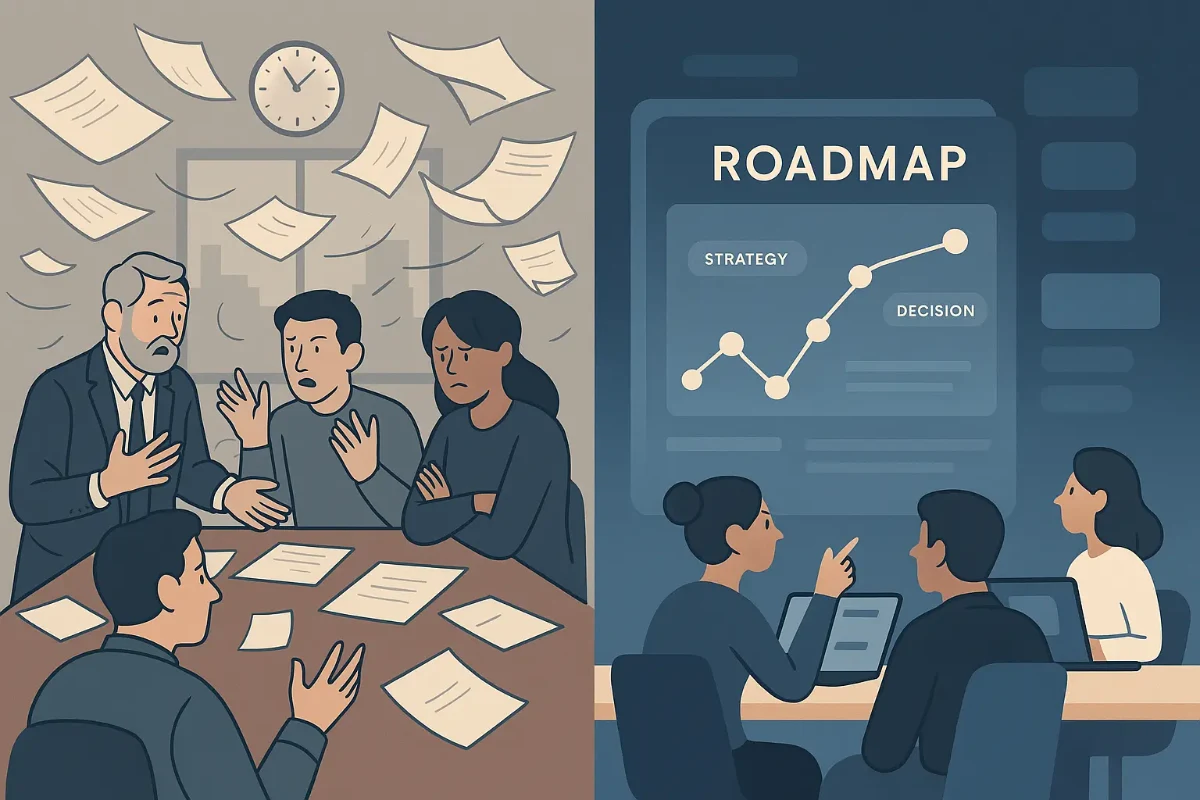
We’ve all experienced it.
A strategy meeting runs long, full of passionate discussion and seemingly aligned decisions. Everyone nods. Slides are updated. Next steps are agreed upon.
Then next week arrives.
- Someone questions the decision.
- Another team member remembers it differently.
- A new person joins the team and has no idea what was decided—or why.
That moment of clarity vanishes.
Strategic clarity fades. Momentum dies. And suddenly, you’re back at square one.
The Real Problem: Human Limits in Strategic Environments
It’s not that your team is disorganized or unprofessional.
It’s that we’re human—and strategy, by nature, is complex, emotional, and layered.
Here’s what typically goes wrong:
- Subjective interpretations: Everyone hears the same sentence differently.
- Memory gaps: Even the best minds can’t retain detailed strategic reasoning over weeks.
- Documentation overload (or underload): Too many notes with no context, or none at all.
- Onboarding lag: Anyone who missed one meeting is two steps behind.
- No feedback loop: Strategy rarely gets connected back to outcomes and real-world signals.
⚠️ Real-World Example:
A product team spent three weeks refining a roadmap.
A month later, a stakeholder asked, “Why didn’t we include Feature X?”
No one could confidently explain the rationale.
The meeting restarted—and the decision was reversed.
This isn’t rare. This is common.
And it’s costly.
The Cost of Strategic Amnesia
- Repeated debates = time lost
- Onboarding inefficiency = team friction
- Misalignment = diluted execution
- No record of reasoning = no accountability
- Missed signals = missed opportunities
In fast-paced companies, these patterns compound.
Teams lose velocity—not because of poor strategy, but because they can’t remember or align on what that strategy was.
trategy Should Be a System—Not a Memory Game
At Priowise, we decided to change the game.
We don’t just use Large Language Models (LLMs) to support strategy.
We use them to embed strategy into how we operate—permanently, reliably, and scalably.
How We Built a Strategic Memory Using LLMs
Here’s how it works step-by-step:
1. We feed LLMs with raw input:
- Meeting notes
- Chat discussions
- Strategic docs
- Decision threads
Nothing is left out—because strategic context lives in the mess.
2. Sentiment & friction are analyzed:
- Did someone raise a concern?
- Was there tension or strong agreement?
- Did a stakeholder push back?
LLMs identify not just the what, but the how and why behind decisions.
3. Market insights are integrated:
- Our system cross-checks decisions with external trends
- Competitor movement and user feedback can be pulled in automatically
- Strategy is now **market-informed, not memory-based
4. Decisions are linked to rationale:
- Every major call is tied to its originating context
- Future team members can access **a living timeline of strategic decisions
5. Recaps are always available:
- Someone missed a meeting?
- Onboarding a new PM?
- Need to explain a choice to leadership?
LLMs generate natural-language summaries with the original reasoning—instantly.
But they make sure your decisions:
- Don’t get lost
- Don’t get misinterpreted
- Don’t get repeated
They amplify your leadership and strengthen your culture of clarity.
Strategy That Lives Beyond the Meeting
Strategic thinking is a muscle.
It grows when exercised—and atrophies when forgotten.
Your team shouldn’t depend on memory to stay aligned.
Your product shouldn’t wait for clarity to arrive.
With the right system in place, your strategy becomes an asset, not a liability.
It evolves with your team. It grows with your market. It lives.
Strategy is too important to leave to memory.
Let’s fix that—together.