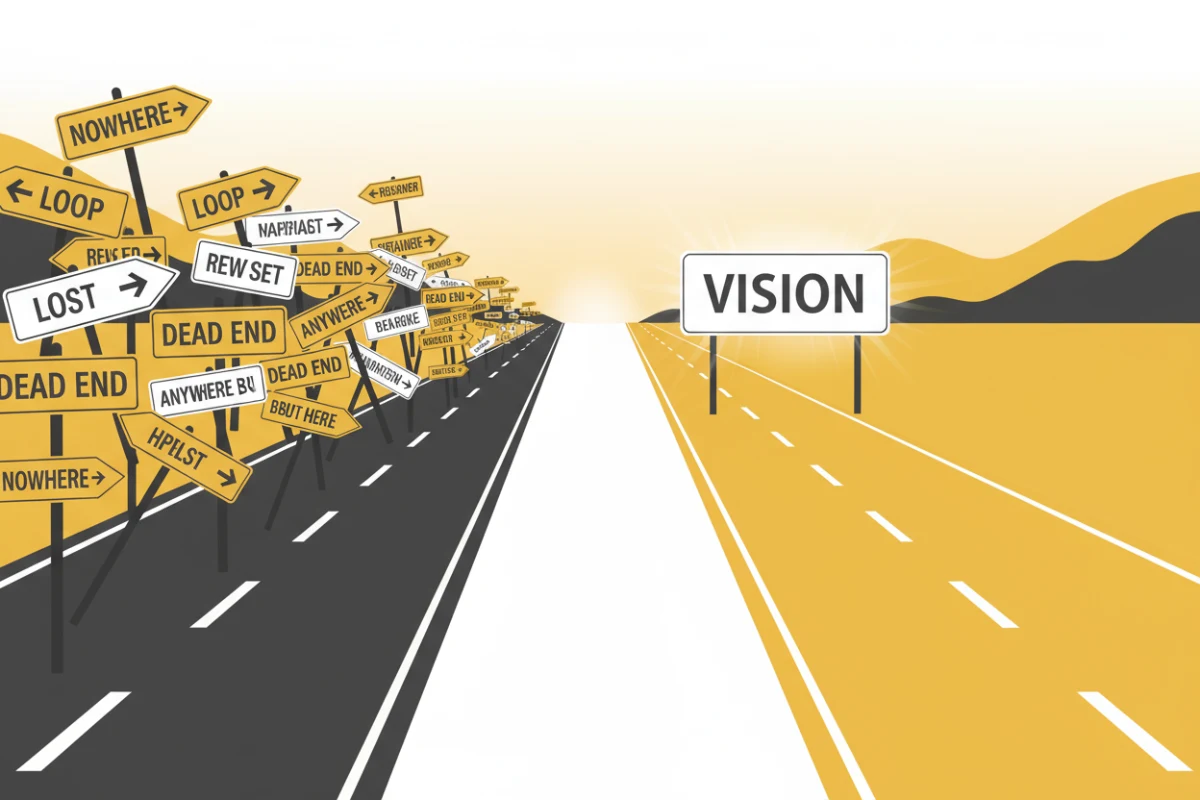
If you ask a product team for their strategy, they’ll often show you their roadmap.
It’s filled with milestones, features, and delivery dates — a visual promise of progress.
But when you ask why these things are on the roadmap, silence often follows.
Roadmaps are supposed to reflect a strategy. Too often, they replace it.
That’s how organizations end up sprinting efficiently in the wrong direction.
A Roadmap Isn’t a Strategy
A roadmap is a plan of action.
A strategy is a system of intent.
Teams confuse the two because both look forward — but they answer different questions.
Strategy / Roadmap
Defines why you’re pursuing certain goals
Defines what and when you’ll deliver
Anchored to business objectives
Anchored to milestones
Evolves with the market
Often static
Owned collectively
Often owned by one team
When the roadmap becomes the only strategic artifact, teams drift.
Execution takes over direction.
The Hidden Cost of a Roadmap-First Culture
When strategy gets reduced to a Gantt chart:
When strategy gets reduced to a Gantt chart:
- Short-term delivery replaces long-term differentiation: Teams chase deadlines, not outcomes
- Leadership loses traceability between vision and features: Roadmaps fill up with requests, not results
The cost isn’t just operational — it’s strategic erosion.
The organization forgets how to decide why something matters.
The Roadmap Should Follow the Strategy — Not Define It
A strong roadmap isn’t a list of features; it’s a narrative of intent.
It reflects priorities driven by impact and informed by strategy.
When teams ask, “Does this item align with our current objective?”, the roadmap evolves intelligently.
Without that discipline, it becomes a backlog with a deadline.
How Strategy-Driven Roadmaps Work in Priowise
At Priowise, we help organizations reconnect strategy → objectives → roadmap through structured intelligence:
Define the Why
LLMs analyze company goals and user insights to identify clear strategic drivers.
Connect the What
Each roadmap item is linked to measurable impact parameters (e.g., revenue potential, retention, scalability).
Validate Continuously
As markets shift, the system re-evaluates priorities based on live data, preventing drift.
Keep Strategy Alive
Every feature and milestone is traceable to its originating decision, rationale, and outcome.
This creates living roadmaps that think — not just timelines that list.
The Results of Strategy-First Thinking
✅ Roadmaps evolve with business goals, not against them.
✅ Teams align on outcomes instead of features.
✅ Leadership tracks impact, not activity.
✅ Strategic clarity compounds over time.
When everyone knows why they’re building, alignment becomes automatic.
When the Roadmap Becomes the Strategy
- Measuring output instead of outcome.
- Confusing “visibility” with “alignment.”
- Treating the roadmap as a one-time artifact.
- Updating the roadmap but not the reasoning behind it.
A Strategy Isn’t a List — It’s a Living System
A roadmap without strategy is directionless.
A strategy without a roadmap is executionless.
Priowise bridges both — turning every decision into traceable alignment.
The Best Roadmaps Start with “Why”
Every team has a roadmap. Few can explain its logic.
When your roadmap becomes a reflection of strategy — not a replacement for it — progress starts to mean something again.
Strategy is clarity.
Roadmaps just follow it.
Mini FAQ
This mini FAQ highlights the key what/why/how points from the post, making strategy alignment concepts easier to understand and reference.*
What’s the difference between a roadmap and a strategy?
A roadmap shows what and when you’ll deliver. A strategy explains why it matters and how it connects to broader objectives.
Why do teams confuse the two?
Because both look forward — but one drives intent, while the other drives execution.
How can organizations connect strategy and roadmaps?
By linking every roadmap item to measurable strategic outcomes and continuously validating its impact.
What happens when the roadmap replaces the strategy?
Teams chase deadlines instead of outcomes, wasting resources and losing direction.
How does Priowise fix this?
By turning strategic intent into a living system that aligns objectives, market data, and execution — automatically.