Many organizations treat strategy like a calendar event.
Once a year.
Sometimes once a quarter.
Often with slides, workshops, and offsites.
Then it’s “done.”
Teams go back to execution. Markets move. Customers change. Competitors adapt.
But strategy? It waits patiently for the next planning season.
That assumption is one of the most expensive mistakes modern product organizations make.
The Myth of Seasonal Strategy
Seasonal strategy assumes three things:
- The market stays relatively stable between planning cycles
- Decisions made months ago remain valid
- Teams remember why those decisions were made
None of these hold true in product-led businesses.
According to Harvard Business Review many companies fail not because they lack strategy, but because strategy doesn’t adapt fast enough to changing conditions.
Strategy treated as a “planning moment” quickly becomes disconnected from reality.
What Seasonal Strategy Really Costs
When strategy is revisited only periodically, organizations pay hidden costs:
- Outdated priorities: Teams execute against assumptions that no longer hold
- Delayed response: Signals appear early, but action waits for the next cycle
- Decision decay: Context behind decisions fades faster than roadmaps update
- Execution drift: Teams optimize locally while strategy stagnates globally
McKinsey highlights that organizations struggle most not with defining strategy, but with keeping it relevant during execution.
The longer strategy stays frozen, the more misaligned execution becomes.
Strategy Is a Continuous Discipline
Markets don’t move quarterly.
Customers don’t give feedback annually.
Competitors don’t wait for your planning cycle.
So why should strategy?
Modern strategy is not:
- A document
- A deck
- A workshop
- A season
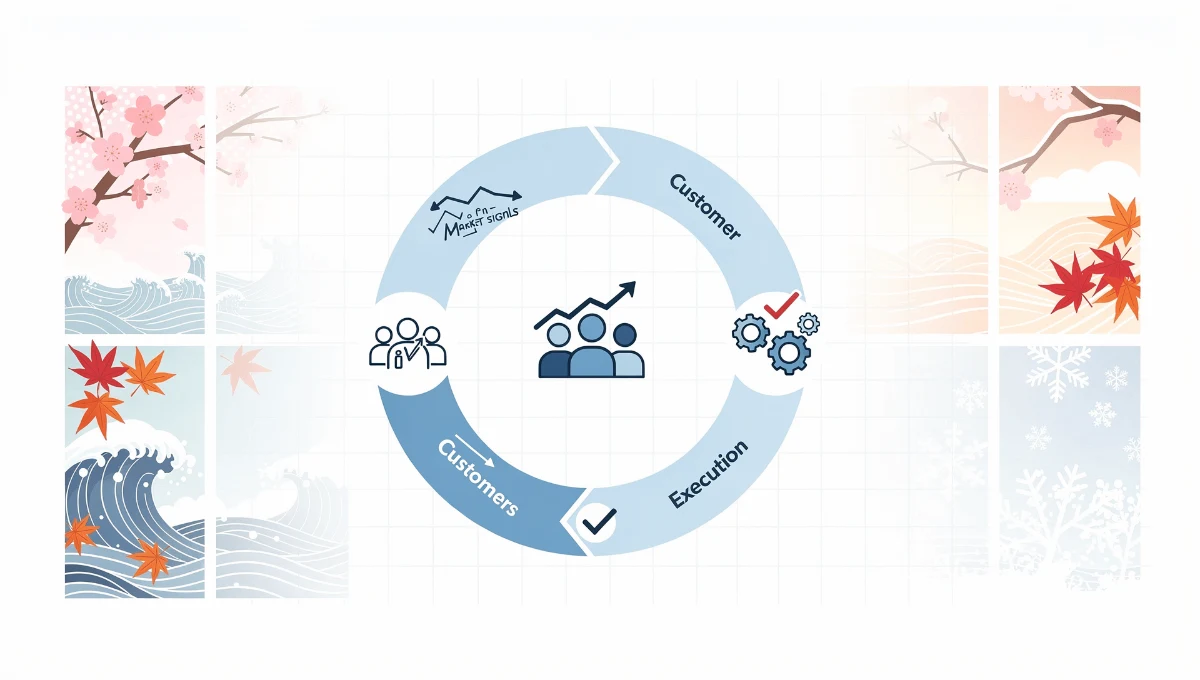
It is an ongoing discipline that continuously absorbs signals, validates direction, and adjusts priorities.
This is not about changing direction constantly.
It’s about continuously validating direction.
Strategy as a Living System
Treating strategy as a system means:
1. Continuous Signal Intake
Customer feedback, market movement, internal execution data—always feeding into strategic context.
2. Persistent Decision Memory
Every major decision retains its why, not just its outcome.
3. Ongoing Validation
Objectives and priorities are checked against reality, not against last quarter’s assumptions.
MIT Sloan Management Review emphasizes that adaptive organizations build systems that continuously sense and respond, rather than relying on periodic planning alone.
Strategy becomes something teams work with, not something they wait for.
What Changes When Strategy Stops Being Seasonal
When strategy is continuous:
- Teams course-correct earlier
- Leaders make fewer reactive decisions
- Roadmaps stay aligned longer
- Execution reflects intent, not habit
Most importantly, strategy compounds instead of resetting.
Each decision strengthens the next—rather than starting from scratch every cycle.
Why Teams Still Treat Strategy as Seasonal
- Planning rituals feel productive
- Continuous strategy sounds “messy”
- Tools track execution better than intent
- No system exists to hold strategic memory
Seasonality isn’t a preference—it’s often a system limitation.
This Is Not About Constant Change
Continuous strategy does not mean:
- Constant pivots
- Endless reprioritization
- Decision instability
It means continuous awareness.
Stable direction.
Adaptive execution.
Validated intent.
Strategy That Pauses, Decays
Execution never stops.
Markets never pause.
Memory always fades.
Only strategy is treated as seasonal.
That imbalance is where misalignment begins.
Strategy isn’t something you return to.
It’s something you operate continuously.
And that’s the shift modern product organizations must make.
❓ Mini FAQ — Strategy Is Not Seasonal
Why do companies treat strategy as seasonal?
Because planning rituals are familiar, while continuous strategy requires systems and discipline.
Is continuous strategy the same as frequent pivots?
No. It’s about validation and awareness, not instability.
How does this affect product teams specifically?
Product teams execute daily decisions; without continuous strategy, those decisions slowly drift from intent.
What enables non-seasonal strategy in practice?
Systems that preserve strategic context, validate priorities, and connect execution back to objectives.
How does Priowise support continuous strategy?
By turning strategy into a living system with persistent memory, validation, and alignment.