
The Real Cost of Misalignment: It’s Bigger Than You Think

Misalignment Is Not Just a “People Problem”
We often talk about misalignment as if it’s just a nuisance—an extra meeting, a bit of frustration, a few slides redone. But the truth is harsher: misalignment eats resources, slows down innovation, and silently erodes trust inside organizations.

The price tag isn’t measured in single mistakes—it compounds over time, multiplying until even the best teams lose momentum.
Here’s what misalignment really looks like in practice:
- Duplicated efforts: teams building overlapping features.
- Conflicting goals: departments chasing different outcomes.
- Delayed execution: roadmaps rewritten every quarter.
- Eroded trust: leadership doubts teams; teams doubt leadership.
Misalignment doesn’t just slow you down—it creates strategic debt.
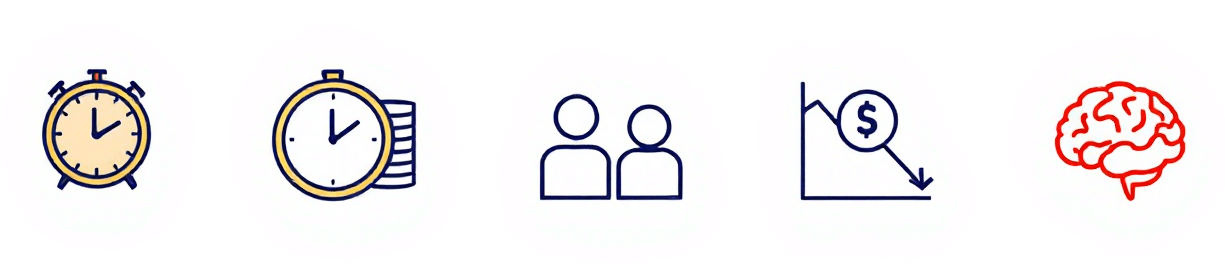
The Hidden Bill of Misalignment
- Time Lost: Weeks wasted in rework, repeated debates, and firefighting.
- Money Burned: Investments in features with little or no impact.
- Talent Drain: Frustrated employees disengage—or leave.
- Market Penalties: Competitors ship faster, customers lose patience.
- Strategic Amnesia: No one remembers why a decision was made, just that it was.
Misalignment isn’t just inconvenient—it hits your bottom line in ways that sneak up if you’re not looking.
According to Mural’s 2025 GTM Alignment Gap Index, 89% of respondents say breakdowns in collaboration directly impact revenue, including through lower retention, missed growth, wasted resources, and slower time-to-market. Another In Parallel study found that misaligned execution costs organizations 5-10% of their annual revenue. Misalignment also imposes indirect costs: duplicated efforts, inefficient handoffs, stalled projects, and team frustration. These amplify the direct losses and often go unmeasured—until it’s urgent. ≈ from Mural’s findings.
Misalignment Isn’t Just Expensive. It’s Optional.
The good news? Misalignment isn’t inevitable. It happens when strategy is treated as a one-off meeting, not a continuous system.
When organizations move from “strategy as slides” → “strategy as a system”, the compounding cost flips into compounding value.
How Alignment Changes the Equation
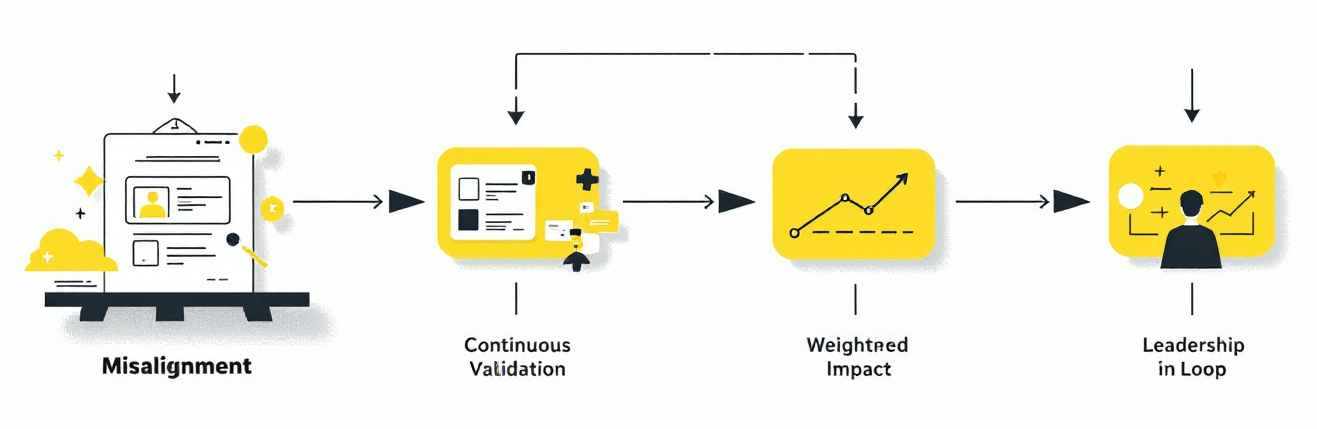
At Priowise, we’ve seen teams regain control by embedding alignment into daily operations:
- Clear Strategic Memory: Every decision linked to its rationale.
- Continuous Validation: Decisions tested against real-time market signals.
- Weighted Impact: Objectives ranked by business-critical outcomes, not gut feeling.
- Leadership in the Loop: Executives connected directly to roadmaps and outcomes.
This isn’t just damage control. It’s prevention.
What Aligned Teams Gain
- ✅ Faster execution
- ✅ Higher ROI on product investments
- ✅ More resilient strategy under market shifts
- ✅ Stronger culture of trust and clarity
When alignment is built-in, the cost of misalignment disappears—and strategic clarity compounds.
Where Companies Go Wrong
- Treating misalignment as “just poor communication.”
- Assuming more meetings = better alignment.
- Ignoring the hidden costs until it’s too late.
- Relying on memory instead of systems.
Alignment Isn’t About Micromanaging
It’s not about locking every decision in stone.
It’s about creating traceable context so teams can adapt quickly without losing sight of the bigger picture.
Final Thought: Misalignment Compounds. So Does Alignment.
Every misaligned decision multiplies downstream costs.
Every aligned decision multiplies trust, speed, and impact.
The real cost of misalignment isn’t the mistake—it’s the repetition.
At Priowise, we’re building systems so alignment is never left to chance.

Mini FAQ
This mini FAQ highlights the key what/why/how points from the post, making strategy alignment concepts easier to understand and reference.
- What is misalignment in product strategy? When teams, leadership, and roadmaps pursue different goals without shared context.
- Why is misalignment so costly? It creates wasted effort, disengaged employees, and slower market response.
- How can companies fix misalignment? By building systems that capture decisions, validate with data, and align execution with strategy.
- What role does leadership play? Leaders must stay in the strategy loop, not outsource alignment entirely to teams.
- How does Priowise help? By turning strategy into a living system powered by AI-driven memory, validation, and prioritization.