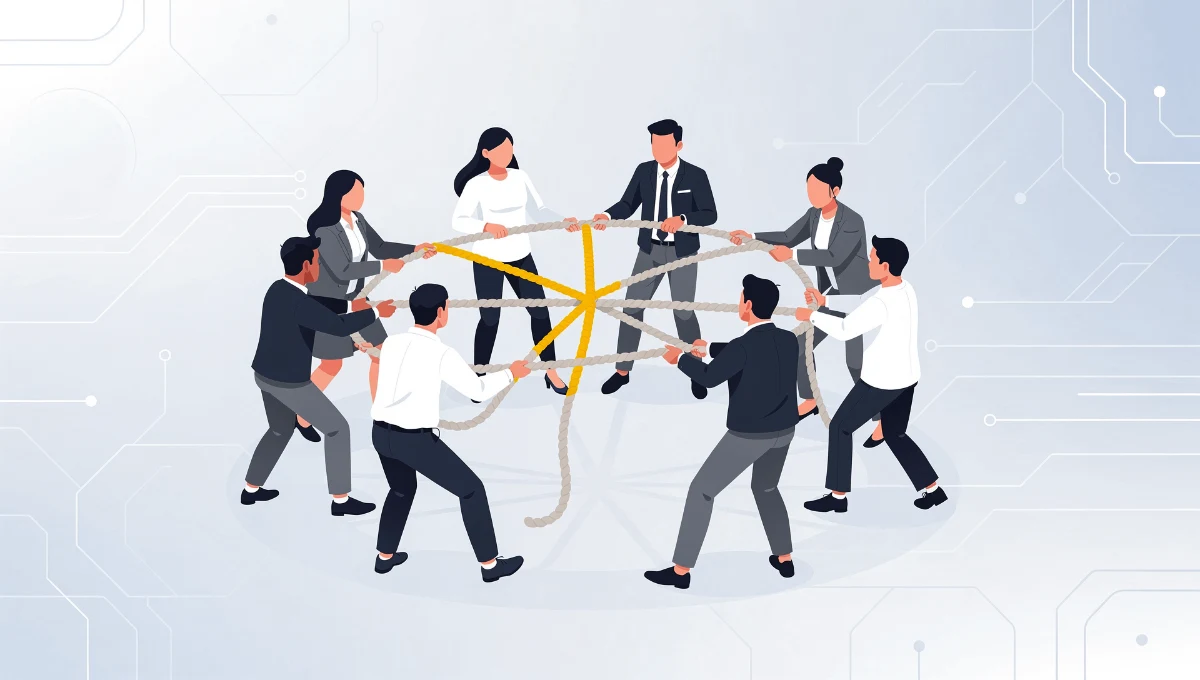
In most organizations, strategy feels like a group project.
Everyone has opinions. Everyone contributes ideas. Everyone is involved.
But when the time comes to make hard calls — to say yes to one path and no to another — silence fills the room.
Suddenly, strategy is everyone’s responsibility… and no one’s accountability.
The result?
A beautifully democratic confusion.
Endless discussion, limited decision, and no clear owner of outcomes.
The Ownership Paradox
When everyone owns strategy, no one truly does.
Leadership expects alignment.
Product teams expect direction.
Marketing expects clarity.
Engineering expects focus.
And everyone — sincerely — believes they’re helping.
But without defined accountability, “helping” turns into “pulling.”
Each team moves in its own version of strategic truth, fragmenting momentum.
The paradox is painful:
- Too centralised → strategy gets stuck in leadership bottlenecks.
- Too distributed → it loses coherence.
In both cases, alignment collapses under the weight of ambiguity.
The Cost of Undefined Ownership
Lack of clear ownership quietly drains organizational energy:
- Conflicting priorities: Teams pursue different versions of “what matters.”
- Duplicated work: Multiple groups solve the same problem differently.
- Strategic drift: Vision loses direction with every handoff.
- Accountability vacuum: Nobody can say what failed — or why.
Research from McKinsey & Company indicates organizations that establish clear ownership structures are significantly more likely to achieve successful strategy execution.
An article by The Strategy Institute emphasizes: “Lack of ownership and accountability … strategies flounder when no one takes direct ownership of goals and execution plans.”
Ownership isn’t control.
It’s clarity.
Strategy Needs Participation — Not Confusion
Strategy shouldn’t live in silos — but it shouldn’t dissolve into a crowd either.
The healthiest organisations treat strategy like a shared system:
- Leaders define direction.
- Teams translate it into execution.
- Systems preserve accountability and visibility.
- It’s not about restricting ownership
- it’s about **structuring it.
Everyone contributes.
Not everyone decides.
And that’s how alignment survives.
How Priowise Makes Ownership Visible
1. Role-Linked Objectives
Priowise connects objectives directly to responsible roles or teams — ensuring every goal has a visible owner.
2. Traceable Decisions
Every strategic decision is stored with context: who made it, why, and what it impacted.
No more “we decided” — every “we” has a name and timestamp.
3. Accountability Maps
Priowise builds an interactive accountability map showing who drives, supports, and validates each objective — eliminating ambiguity.
4. Shared Alignment, Clear Ownership
Different teams can collaborate on the same strategic path while retaining ownership clarity.
Shared vision, distributed action, centralised accountability.
5. Outcome-Driven Transparency
By linking impact metrics to owners, Priowise ensures recognition and responsibility travel together — not apart.
When Ownership Becomes Clarity
✅ Everyone knows what they’re accountable for.
✅ Cross-functional teams move with purpose.
✅ Decisions are traceable and defensible.
✅ Strategy becomes measurable, not mythical.
When ownership is visible, alignment becomes inevitable.
How Ownership Gets Lost
- Mistaking collaboration for accountability.
- Letting leadership “sign off” without follow-through.
- Treating strategic alignment as a one-time exercise.
- Avoiding ownership because it feels political.
The cost of avoiding ownership is always higher than the discomfort of defining it.
AI Doesn’t Replace Ownership — It Makes It Transparent
Priowise doesn’t assign accountability — it reveals it.
By tracking strategic decisions, owners, and outcomes, Priowise creates a living, transparent record of who owns what — and how it contributes to shared objectives.
That’s not micro-management.
That’s clarity.
Strategy Belongs to Everyone. Accountability Belongs Somewhere.
Every great company has passionate teams.
But passion without ownership is chaos disguised as collaboration.
Strategy doesn’t die because people disagree.
It dies because no one knows who’s supposed to carry it forward.
Priowise brings that clarity back — showing not just what’s being done,
but who’s responsible for making it happen.
Because strategy without ownership isn’t alignment.
It’s entropy.
❓ Mini FAQ — Who Owns Strategy? Everyone and No One.
Who should own strategy?
Leadership defines direction, but ownership is distributed through accountable roles tied to measurable outcomes.
Why does shared strategy often fail?
Because shared responsibility without structure leads to confusion — everyone feels responsible, but no one is accountable.
How does Priowise define ownership?
By linking every objective and decision to explicit owners, contributors, and validation roles.
Does this reduce collaboration?
No — it enhances it by providing clarity, so collaboration builds alignment instead of chaos.
How does Priowise make ownership visible?
Through accountability mapping, role-linked objectives, and impact-based tracking.